

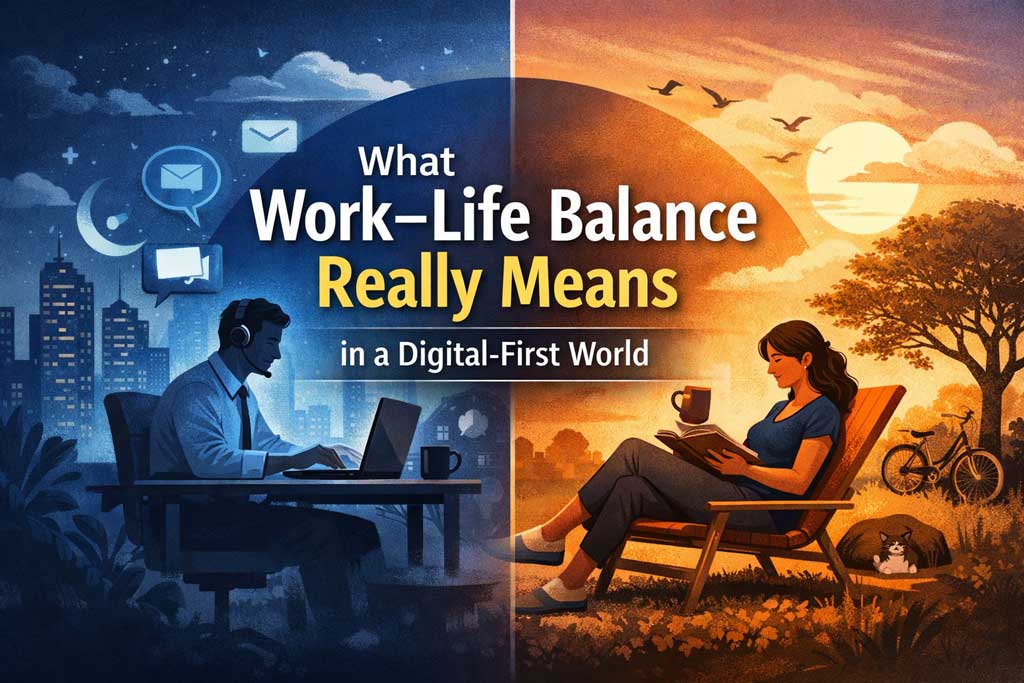
Work–life balance isn’t what it used to be.
It once meant leaving the office at 6 PM and switching off.
That model no longer fits how we work today.
Emails follow us home. Messages arrive at night. Work apps live in our pockets.
In a digital-first workplace, work is no longer tied to a location—or a schedule.
So what does work–life balance actually mean now?
And how do you maintain it without burning out?
Let’s break it down—clearly and practically.
What Is Work–Life Balance in a Digital-First World?
Today, work–life balance is not about equal hours.
It’s about:
-
Control
-
Boundaries
-
Energy management
-
Sustainability
In a digital-first environment, balance means:
-
Having control over when and how you work
-
Being able to disconnect without guilt
-
Managing energy—not just time
-
Making work fit into life, not replace it
Balance looks different for everyone. And that’s normal.
Why the Digital-First Workplace Changed Everything
Digital tools increased flexibility—but blurred boundaries.
Major shifts include:
-
Remote and hybrid work becoming standard
-
Global teams working across time zones
-
Constant, real-time communication
-
Increased expectations of availability
-
Work apps installed on personal devices
Work is now “always accessible.”
Without intentional digital workplace boundaries, work slowly expands into personal time.
That expansion is subtle—and dangerous.
Common Myths About Work–Life Balance
1. Balance Means Working Fewer Hours
Not necessarily.
Some professionals work long hours and still feel balanced because:
-
They have autonomy
-
They feel purposeful
-
They control their schedule
Balance is about agency, not just hours.
2. Balance Is a Personal Discipline Issue
It’s not just about self-control.
Work–life balance is shaped by:
-
Leadership behavior
-
Company culture
-
Workload design
-
Response-time expectations
If leaders reward constant availability, employees adapt accordingly.
3. Digital Tools Automatically Improve Balance
Productivity tools help track and analyze work.
But tools don’t create boundaries—you do.
Technology without limits often increases digital overload.
What Work–Life Balance Looks Like in Practice
Real balance is simple—and often boring.
Examples of healthy digital boundaries:
-
Not responding to non-urgent messages at night
-
Blocking focus time without interruption
-
Taking leave without checking Slack
-
Not feeling pressure to appear “always online”
-
Logging off without anxiety
Balance is less about hacks.
More about clear, repeatable decisions.
How Work–Life Balance Differs by Role
Balance is not one-size-fits-all.
Knowledge Workers
Challenges:
-
Meeting overload
-
Constant notifications
-
Cognitive fatigue
Need:
-
Deep work blocks
-
Fewer unnecessary meetings
-
Clear async norms
Managers and Leaders
Challenges:
-
Availability pressure
-
Decision fatigue
-
Responsibility spillover
Need:
-
Delegation clarity
-
Defined communication windows
-
Modeling disconnection
Freelancers & Entrepreneurs
Challenges:
-
Income tied to responsiveness
-
Blurred work/home environment
-
Self-imposed pressure
Need:
-
Defined client boundaries
-
Structured work hours
-
Non-work rituals
Frontline & Operations Roles
Challenges:
-
Fixed schedules
-
Limited flexibility
Need:
-
Predictable time off
-
Clear overtime policies
-
Respect for recovery time
The Employer’s Role in Work–Life Balance
Work–life balance in a digital-first world cannot survive without leadership alignment.
Healthy organizations:
-
Set clear response-time expectations
-
Respect time zones
-
Measure output—not online presence
-
Encourage time off
-
Avoid glorifying overwork
-
Model healthy digital behavior at the top
If leaders never disconnect, teams won’t either.
Practical Ways to Improve Work–Life Balance Today
Small changes are more sustainable than drastic resets.
At the Individual Level
-
Turn off non-essential notifications
-
Set clear start and end work times
-
Communicate availability proactively
-
Protect one daily non-work activity
-
Avoid checking email immediately after waking
At the Team Level
-
Agree on response-time norms
-
Reduce recurring low-value meetings
-
Use async communication when possible
-
Document decisions clearly
At the Organizational Level
-
Train managers on workload planning
-
Monitor burnout indicators
-
Reward sustainable performance
-
Normalize “offline” behavior
Work–life balance improves when systems support it.
Work–Life Balance and Mental Health
Imbalance builds slowly.
It doesn’t explode overnight.
It accumulates.
Early warning signs:
-
Constant tiredness
-
Irritability
-
Loss of focus
-
Feeling “always behind”
-
Reduced motivation
According to the World Health Organization, burnout is a workplace phenomenon linked to chronic stress that has not been successfully managed.
Prevention is easier than recovery.
Remote work burnout prevention requires proactive boundaries—not reactive breaks.
FAQs: Work–Life Balance in a Digital-First World
What is work–life balance in simple terms?
Managing work in a way that preserves enough time, energy, and focus for personal life and well-being.
Is work–life balance possible with remote work?
Yes—but only with defined digital workplace boundaries and realistic expectations.
Does flexibility improve work–life balance?
Flexibility helps when combined with trust and limits.
Without boundaries, flexibility becomes constant availability.
Who is responsible for work–life balance?
Both employees and employers share responsibility.
Individuals set boundaries. Organizations create conditions that respect them.
Key Takeaways
-
Work–life balance today is about control—not equal hours
-
The digital-first workplace requires clear boundaries
-
Balance looks different across roles and industries
-
Employers play a critical role in preventing burnout
-
Small, consistent changes are more effective than extreme resets
Final Thought
This week, review how you work.
Not to optimize more.
But to protect what matters.
And if you’re a leader, ask one question:
“Are we rewarding results—or constant availability?”
The answer defines your culture.